
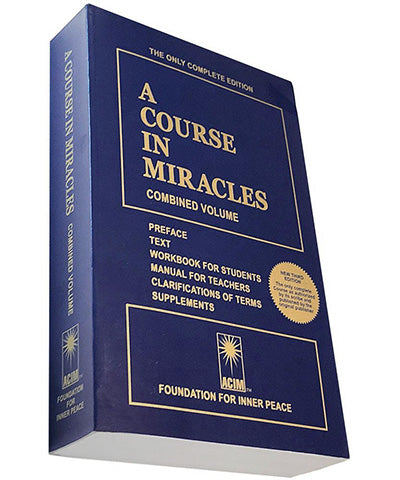
Cover image © Foundation for Inner Peace
A Course in Miracles (ACIM) holds a special place in my heart due to how profoundly it has changed my life. When it comes to spiritual practices, I strongly believe that both an energy-based meditation practice and a high-reaching thought system are key to fast and effective spiritual growth.
High-reaching thought systems act as a compass, helping us see our desired destination. They also act as a magnet, as starting to think or perceive from a higher place draws you up and helps you shed limiting beliefs or energies. The line between an energy practice and a high-reaching thought system is a bit blurred as thought systems and energy practices overlap to an extent in practice.
That said, ACIM is one of the most effective and beautiful thought systems I’ve ever encountered and could easily be your one and only spiritual practice.
Of course, you don’t need to meditate or believe in God/Source to grow spiritually, but I truly believe these things accelerate growth tremendously. It’s like eating healthy and working out—you don’t have to do either to play a sport well, but they help immensely if you want to thrive as an athlete. Perhaps a bit over-simplified, but hopefully you get the idea!
How A Course in Miracles Came to Be
In 1965 a psychologist and educator who identified as an atheist began to hear an inner voice, which was dictating ACIM. With the encouragement of her colleague, she began to write what was being dictated. Seven years later, ACIM was complete.
As written in the preface of the Course by Helen, the medium: “I was still very surprised when I wrote, ‘This is a course in miracles.’ That was my introduction to the Voice. It made no sound, but seemed to be giving me a kind of rapid, inner dictation which I took down in a shorthand notebook. The writing was never automatic. It could be interrupted at any time and later picked up again. It made me very uncomfortable, but it never seriously occurred to me to stop. It seemed to be a special assignment I had somehow, somewhere agreed to complete.”
Non-Dual Thought Systems & Accessibility
Over the years, I’ve found non-dual spiritual teachings to be the most profound and highest reaching ones. While I believe the non-dual teachings of Nisargadatta and Ramana Maharshi are the pinnacle of non-dual thought, ACIM shines in its ability to convey these principles into forms that are often more approachable and practical.
Nisargadatta and Ramana’s teachings stay at the level of pure non-duality and rarely descend to meet the ego where it is, whereas ACIM switches between the perspective of the ego and the non-dual perspective of Source, formulating a very robust and complete thought system.
Ramana often stated that his highest teaching was his silent presence, his direct connection and expression of these higher states of being. If you can tap into that with his picture, videos, or his teachings, it’s incredible Yet even then, A Course in Miracles can still very likely help you in ways you didn’t realize you were stuck.
While Ramana might ask, “Who is it that is angry?” ACIM will approach the issue from 100 different angles. Really, I think it’s helpful to have both (and many more), so that if one doesn’t inspire you on a given day, the other likely will.
What the Course Teaches - Forgiveness and the Meaning of Miracles
A Course in Miracles teaches non-duality from within duality, using poetic biblical language and concepts—though it isn’t the same as modern Christianity. It teaches the inherent sinlessness of mankind, emphasizing that what we call sin is not real but a mistaken perception. In this view, guilt and sin are illusions the ego clings to as a defense against God, while our true nature remains untouched.
The most central practice of ACIM is forgiveness. Unlike traditional forgiveness, which assumes real harm but chooses to overlook it, ACIM’s forgiveness rests on the recognition that no true harm has ever, or could ever occur. By releasing others from guilt (or sin), we release ourselves as well. This allows love to take the place of fear, anger, or hatred. This is how forgiveness becomes the key to performing “miracles”.
Miracles as defined by ACIM, are not a supernatural physical event, but instead represent the shift from fear to love. It is a miracle to align one’s will with the will of God and reestablish peace. Our true inheritance.
The Structure of the Course
Its main teachings are divided between the text and the workbook. The text establishes the framework for the thought system and the workbook, the practical application.
What’s great about A Course in Miracles is that—even though the concepts can be quite challenging for those who haven’t had exposure to non-duality or who lean agnostic—it works very well without requiring a strong focus-based meditation background. That said, just like focused based meditations, such as Vipassana or Zen, it does greatly benefit from dedication, sincerity and strong desire for growth.
The lessons vary in length and format. Some are just a sentence to reflect on each hour for a minute or so, and others call for 15-30 minutes of focused attention twice a day.
The lessons are designed to gently dismantle your ego and replace it with a higher understanding. For example:
“I don’t know what anything is for”
“I am not a body. I am free. For I am still as God created me.”
Getting Started with ACIM
For those new to A Course in Miracles, or to non-dual teachings in general, it can be a difficult book to dive into without some prior context. I strongly recommend a book titled The Disappearance of the Universe by Gary Renard. It explains the teachings of ACIM in a much more understandable format. Even if his style or sources don’t resonate with you, it is still a fantastic introduction.
I would also like to give some reassurance to those just starting. You don’t need to grasp everything the Course says immediately. It is the effect on your consciousness that matters most. When I first started, I would read a few paragraphs and wouldn’t be able to tell you a word I read, but I felt the effect it had on me and so was encouraged to keep going.
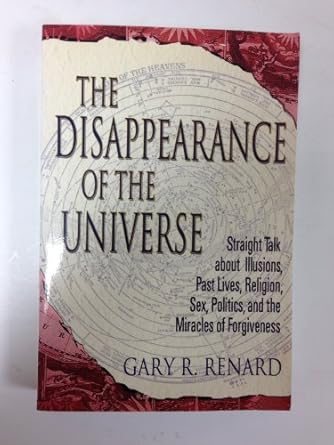
Cover image © Hay House / Gary R. Renard
Final Thoughts
I don’t think I could ever do a better job at representing A Course in Miracles than the Course itself, so I’ll end with its opening words, which brilliantly encapsulate its message:
“This is a course in miracles. It is a required course. Only the time you take it is voluntary. Free will does not mean that you can establish the curriculum. It means only that you can elect what you want to take at a given time. The course does not aim at teaching the meaning of love, for that is beyond what can be taught. It does aim, however, at removing the blocks to the awareness of love’s presence, which is your natural inheritance. The opposite of love is fear, but what is all-encompassing can have no opposite.
This course can therefore be summed up very simply in this way:
Nothing real can be threatened.
Nothing unreal exists.
Herein lies the peace of God”
Side note:
Some people get caught up on the phrase “this is a required course.” After practicing A Course in Miracles for almost 10 years, I understand this not as a declaration that this particular course is required, but that the learning itself is. That’s why it’s called “A” Course in Miracles—not “The” Course in Miracles. The text clarifies this distinction later on as well.